
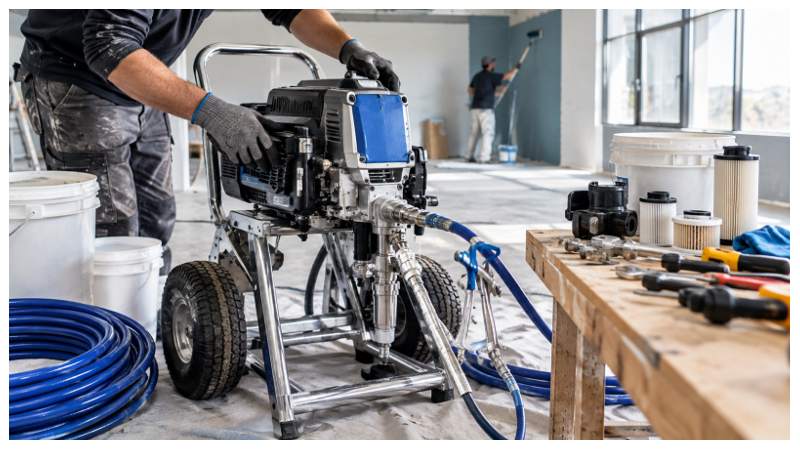
Sticker price is the easiest number to compare when you are shopping for a sprayer, and also the least useful one. The Titan Impact 1040 sits toward the top of Titan’s electric lineup, built for large scale jobs that call for bigger tip sizes or multiple guns running off one pump. Understanding what it actually costs to own, not just to buy, is the real question worth answering before you commit that kind of budget to a single machine.
1. What You Are Paying For Up Front
The 1040 is designed around a heavier duty motor and drive system than the mid-tier Impact models, built to handle the extra strain of running large tip sizes or multiple spray guns simultaneously without shortening the machine’s service life. That capacity is exactly what large residential, commercial, and industrial jobs demand, where a smaller pump would be constantly working at its limit and wearing out faster as a result.
The main assembly carries the control panel, transducer, and drive components that regulate pressure and flow across whatever configuration you are running. Because this machine is often deployed on jobs with multiple guns or larger orifice tips, the precision of that pressure regulation matters more here than on a smaller single-gun sprayer, where small inconsistencies are less noticeable. A control panel assembly for the 1040 is a meaningful purchase on its own, which is exactly why keeping the original in good condition through proper maintenance is worth the effort.
2. Parts and Maintenance Costs Over the Machine’s Life
Every sprayer accumulates ongoing costs beyond the purchase price, and the 1040 is no exception. Filters, packing sets, and wear items on the fluid section need periodic replacement regardless of how well you maintain the machine, simply because they are consumable by design. What separates a well managed cost of ownership from a surprising one is whether those replacements happen on a planned schedule or only after something fails mid-job.
A machine this size also tends to accumulate more running hours per week than a smaller sprayer, since it is usually deployed on larger jobs that take longer to complete. More hours means wear items reach their replacement point faster in calendar time, even if the cost per gallon sprayed stays the same. Budgeting for that reality up front, rather than treating each repair as an unexpected expense, is what separates contractors who see strong ROI from this machine and those who feel like it is constantly costing them money.
3. Calculating the Actual Return
Evaluate the machine by calculating its cost per gallon sprayed, including the purchase price, annual parts and maintenance expenses, and labor hours it saves compared with using a smaller pump or several smaller machines for the same job, rather than simply dividing its purchase price by an estimated lifespan.
For a contractor running large commercial jobs regularly, a single 1040 often replaces what would otherwise require two smaller sprayers working in parallel, along with the added crew coordination and setup time that involves. When you price out the alternative honestly, including labor and the friction of running multiple machines on one job site, the 1040’s higher purchase price frequently comes out ahead within the first year or two of consistent use.
4. Building a Simple Maintenance Budget
A practical way to keep this machine’s cost of ownership predictable is to set aside a fixed percentage of what the machine earns each month toward its own upkeep, rather than treating maintenance as an unplanned expense that competes with other business spending. Even a modest reserve, tracked consistently, tends to cover routine filter and packing replacements comfortably and leaves a cushion for the occasional larger repair without disrupting cash flow.
Pair that budget with a simple maintenance log noting when filters were last changed, when the piston was last serviced, and how many hours or gallons the machine has run since. That kind of record turns guesswork into a schedule, and a machine serviced on a schedule almost always costs less over its life than one serviced reactively after something already went wrong.
5. Where the Costs Can Get Away From You
The biggest risk to a good return on this machine is neglect, not the machine itself. Skipping filter changes to save a few dollars here and there leads to increased strain on the motor and fluid section, which turns a routine maintenance item into an expensive repair down the line. Running the machine dry on lubricant, even briefly, accelerates packing wear far faster than the actual cost of the lubricant would suggest.
The other common cost overrun comes from downtime rather than parts. If a component fails and the replacement takes days or weeks to arrive, the lost production time on a large commercial job can dwarf the cost of the part itself. This is where buying from a supplier with same-day shipping on common wear items genuinely changes the total cost equation, because the part itself is rarely the expensive piece. The idle crew and delayed job completion are.
6. Financing the Purchase Responsibly
It is worth revisiting that financing plan annually rather than setting it once and forgetting it, since a growing operation’s cash flow and job mix can shift enough within a year or two to justify renegotiating terms or paying down the balance faster than originally planned.
Given the size of this investment, it is worth financing the 1040 in a way that matches how it actually earns money for your business rather than straining cash flow in the months immediately after purchase. Many equipment lenders and even some distributors offer terms structured around typical contractor cash flow, spreading the cost across the jobs the machine will actually help you complete rather than requiring the full amount up front. Matching the financing structure to the machine’s earning pattern keeps the investment from becoming a cash flow problem in its first season, even while it is generating strong long term returns.
7. Fleet Considerations for Larger Operations
For contractors running more than one large sprayer, standardizing on the 1040 across multiple crews brings additional savings that a single machine cost analysis will not show. Shared training, since every operator learns the same control panel and maintenance routine. Shared spare parts inventory, since a filter or packing set that fits one machine fits them all. And shared familiarity when something goes wrong, since a technician who has fixed one 1040 can troubleshoot another quickly rather than starting from scratch on an unfamiliar platform.
That standardization effect compounds over a fleet in a way that is easy to underestimate when you are only evaluating the purchase of a single unit, but it becomes one of the strongest arguments for sticking with a proven platform once your operation scales past two or three machines.
8. The Bottom Line on Ownership Cost
The Impact 1040 is not a machine you buy on impulse, and it should not be evaluated on purchase price alone. Factor in the labor savings from running one machine instead of two, the actual annual cost of consumables and maintenance, and your access to fast parts when something does need replacing. Contractors who run the numbers honestly and maintain the machine on a schedule rather than reactively tend to find the 1040 pays for itself faster than the initial price tag would suggest, which is really the only number that matters once the purchase decision is behind you.