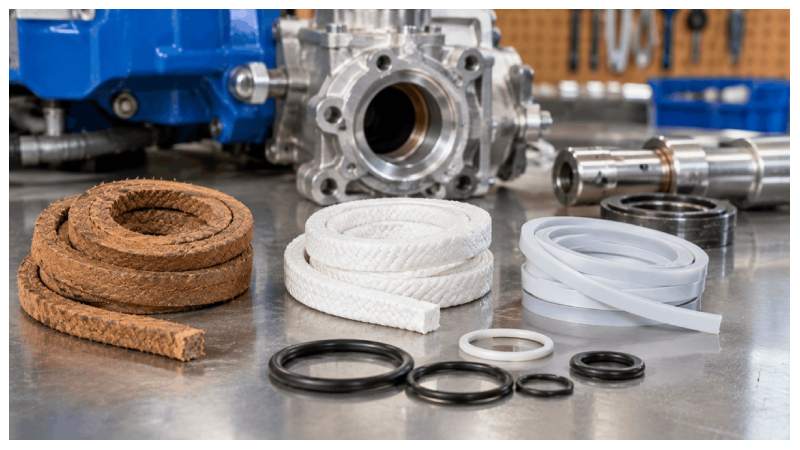
Pump packings are the seals that keep paint from leaking past the rod and from slipping past the piston, and the three materials you will meet most often are leather, polyethylene (UHMWPE) and PTFE. Leather and UHMWPE together are the usual choice for abrasive coatings, PTFE is chosen for chemical resistance and heat, and a combination of UHMWPE and PTFE sits between them. Which one your pump needs depends on the pump, the coating and what the manufacturer fitted at the factory, so the first rule is to match the packing to the lower, not to the price.
That sounds simple until you open a parts list and find three kit families for the same pump size, each with a different code and a different count of rings in the stack. This article explains what each packing material is good at, how a stack is built, what the codes in a catalogue mean and how to tell, from the symptoms on the job, that it is time to replace them. The examples come from Graco’s Xtreme lowers because they are the pumps contractors ask about most, but the same logic applies to most piston pumps that use v-packings.
Key takeaways
- Packings are stacks of v-shaped rings. One stack seals the rod at the throat, a second stack seals the piston inside the cylinder.
- Leather with UHMWPE is the traditional abrasive-service stack, PTFE is for chemical resistance and heat, and UHMWPE with PTFE is the in-between choice for chemical resistance below 140 F.
- The number of rings and the direction they face are part of the design. Counting and orientation matter as much as the material.
- Paint on the outside of the pump, a pump that will not hold pressure and a stroke that is weak in one direction are the classic signs of worn packings.
- Buy the kit that matches the size and packing code on your pump’s ID plate, and replace the whole set at once.
What packings do inside an airless pump
An airless lower is a simple machine. A rod moves up and down, a piston valve rides on the end of the rod inside a cylinder, and two check valves (the inlet ball at the bottom and the piston ball) turn that motion into a one-way flow of paint. Two places need to be sealed against pressure that can run to thousands of psi. The first is where the rod passes through the top of the pump, the throat. The second is the gap between the piston valve and the cylinder wall.
Each of those seals is a stack of v-packings held between two glands. As pressure builds, the lips of the rings are pushed outward against the rod or the cylinder, which is how a ring can seal harder as the pressure goes up. On Graco’s Xtreme lowers the throat stack is tightened by a packing nut, and the stack is topped up with throat seal liquid (TSL), a lubricant that stops paint drying on the rod. Graco’s maintenance guidance says to check and top up the liquid daily.
The three materials and where each one fits
Graco’s Xtreme lowers manual groups the available stacks by material. The catalogue codes are different from the manual’s names, so it helps to see both side by side.
| Catalogue code | Graco’s name | Older trade name | What it is generally chosen for |
| L/PE | UHMWPE and leather | Xtreme Seal | Abrasive coatings. Standard in Graco’s Xtreme NXT air packages. |
| TFE (or PTFE) | PTFE (carbon-filled) | Tuff-Stack | Chemical resistance and higher temperatures. The manual does not recommend it for abrasive materials. |
| TFE/PE | UHMWPE and PTFE | X-Tuff | Chemical resistance and durability below 140 F (60 C). Standard in Graco’s XP proportioners. |
Leather and UHMWPE (L/PE)
Ultra-high-molecular-weight polyethylene is a tough, slippery plastic that stands up to abrasion, and leather is a soft, springy material that follows the surface of the rod and cylinder as they wear. Put them in one stack and you get a seal that tolerates the gritty, filled coatings that chew up harder plastics. That is why this combination is the standard fit on Graco’s Xtreme NXT packages, which are built for protective coatings. The trade-off is care. Leather has to be soaked before assembly, and Graco’s pump repair instructions call for soaking leather packings in SAE 30W oil for about an hour before they go in.
PTFE
PTFE is the material to think about when the coating is chemically aggressive or hot. The Xtreme manual lists a carbon-filled PTFE stack, formerly sold as Tuff-Stack, for chemical resistance and higher temperatures, and it says plainly that this stack is not ideal for abrasive materials. A PTFE stack in a pump that spends its life on abrasive, heavily filled coatings is working against the manual’s own guidance.
UHMWPE and PTFE (TFE/PE)
The third stack combines both plastics. Graco’s manual describes it as the choice for chemical resistance and durability below 140 F (60 C), and it is the packing used in the XP proportioners. Think of it as the choice when you want the chemical resistance of PTFE without giving up all of the wear resistance of polyethylene, and when the pump will not run hot.
How a packing stack is built
The material is only half of the story. A stack is a specific number of rings in a specific order and facing a specific direction, and kits for the same pump size are not interchangeable if the counts differ. Graco’s Xtreme lowers manual lists the current stacks as follows.
| Packing material | Throat stack | Piston stack |
| L/PE (UHMWPE and leather) | 4 UHMWPE and 3 leather | 3 UHMWPE and 2 leather |
| PTFE | 7 PTFE | 5 PTFE |
| TFE/PE (UHMWPE and PTFE) | 4 UHMWPE and 3 PTFE | 3 UHMWPE and 2 PTFE |
Two details in the manual catch people out. The first is direction: the throat v-packings go in with the lips facing down, and the piston v-packings go in with the lips facing up. A stack installed upside down may look fine and leak immediately. The second is age. Older kits listed a five-packing throat stack, and the current stack is different, so a set bought from an old parts list is not necessarily identical to the set the manual shows today.
There is also a difference between a full kit and a partial one. A full Graco Xtreme packing kit holds the throat stack, the piston stack and the o-rings and balls that wear at the same time. Throat-only and piston-only kits exist too, and they make sense when you know exactly which end failed. Most shops replace both, because the rings that did not fail are usually close behind.
Reading the code on the page and the plate
Start with the ID plate on the lower. The six-digit lower number tells you the family. In Graco’s coding scheme a model such as L180C1 reads as a lower (L), 180 cc per cycle, carbon steel (C), with the last digit identifying the filter and packing option. That is the number to match, not the name the pump is known by on the job. Names are less reliable: in the 2001 manual the 145cc lower was called a 600, the 180cc a 750 and the 220cc a 900, while current manuals use cubic centimeters only.
From there, work through four checks before you order.
- Pump size. The cc figure decides which kit family applies. A kit for a 180cc lower will not seal a 220cc lower.
- Packing material. Look at the code on the plate and at the kit you are replacing. Replacing L/PE with PTFE, or the reverse, changes how the pump behaves with your coating.
- Throat or piston, or both. A full kit covers both stacks. Use a partial kit only when you are sure.
- Series and revision. Rods and piston valves are model-specific, and some small parts such as filter-cap o-rings differ between series, so read the plate rather than assuming.
If you are shopping for a Graco Xtreme packing kit, the page is organized by lower size, and each listing shows the Graco number it replaces, which lets you check the match before you order. These are aftermarket parts, made by a company other than Graco, so check the warranty terms for your own equipment with the pump maker before you rely on them. You can also compare current kit numbers in the manufacturer’s manual: for the 145cc to 290cc lowers the current full kits are 25D234 to 25D238 in the L/PE family, 25D244 to 25D248 in PTFE and 25D258 to 25D262 in UHMWPE and PTFE.
How to tell the packings are failing
Manufacturers do not publish a packing life in hours or gallons, and the Graco documents we reviewed do not either. The honest answer is that packings are replaced on symptoms and on inspection. These are the symptoms to watch for.
- Paint on the outside of the pump or running down from the packing nut. That is the classic sign of throat packings wearing out. Graco’s Magnum guidance says to replace the packings at the first sign, before the leak reaches the drive train.
- A pump that will not hold pressure. If the pump keeps stroking when the gun is closed, or the pressure falls away when you stop spraying, the seals or check valves are letting fluid through.
- Weak output in one direction. For Xtreme lowers, Graco’s troubleshooting tables point to the intake valve when output is low on the downstroke, and to the piston valve or the packings when output is low on the upstroke or the pump runs erratically.
- Low output on both strokes on an e-Xtreme sprayer is attributed to worn piston packing.
- A pump that will not start after sitting. Fluid dried on the rod can seize a stroke, and it is one more reason to leave the pump at the bottom of its stroke overnight and keep the throat seal liquid topped up.
For a longer walk through these signs, see the guide on airless pump packings and the article on how to spot worn Graco pump packings before they cost you a day of work.
Adjusting the packing nut without making things worse
When the nut weeps, the instinct is to tighten it. A small adjustment is legitimate. On an Ultra 395 PC, Graco’s schedule says tightening the throat nut when the packings leak buys roughly 100 more gallons before repacking. That figure is for that machine, and it is the only packing-related number in the documents we reviewed, so do not treat it as a rule for other pumps.
More tightening is not better. Graco warns that a nut that is too tight restricts the rod and overloads the motor, and the sprayer may run for 5 to 10 minutes and then stop. The fix is to back the nut off and, if the leak returns, replace the packings. On Xtreme lowers there are also specific torque values for the packing nut during assembly, and the torque used for the daily in-service check on the NXT air package is a different, lower number. Use the one in your own manual for the job you are doing.
A note on safety
Fluid at working pressure can pierce skin and look like a minor cut while causing serious injury. Graco’s manuals say never to put your hand, a rag or a glove over a leak or a tip, and to lock the gun whenever you are not spraying. Relieve the pressure before you touch a fitting. If a clogged tip or hose is suspected, loosen the tip guard nut or the hose coupling very slowly. If an injection injury happens, it is a medical emergency: get treatment at once and show the doctor the medical alert card supplied with the gun.
Frequently asked questions
Are leather packings better than plastic ones?
Neither is better in every case. Leather stacked with UHMWPE is the standard choice for abrasive coatings on Xtreme lowers because it wears well against filled materials. PTFE is chosen for chemical resistance and heat. The right answer depends on your coating and on what the pump was designed for.
How often should I replace pump packings?
There is no published interval in hours or gallons in the Graco documents we reviewed. Replace the packings when the symptoms appear, and inspect the rod and cylinder for scoring every time the pump is open.
Can I replace only the throat packings?
Yes, throat-only and piston-only kits exist. Most shops replace both, because the part that did not fail has usually done the same work and is close behind. If you change only one stack, inspect the other before you close the pump.
Do I always need throat seal liquid?
Graco’s Xtreme and Ultra manuals call for it, and its job is to stop paint drying onto the rod and the packings. Some pumps, such as Graco’s Magnum line, are treated differently: Magnum owners are told to use Pump Armor after use instead of throat seal liquid. Follow the manual for your own machine.
Summary
Packings are the wear parts that decide how long a pump holds pressure. Leather with UHMWPE is the standard for abrasive coatings, PTFE is for chemical resistance and heat, and the UHMWPE and PTFE combination covers chemical resistance below 140 F. Match the kit to the cc size and the packing code on the ID plate, replace the full set, soak leather first, fit the rings in the right direction and watch for paint at the nut and a pump that will not hold pressure. That routine costs a little time on the bench and saves the long afternoon of a pump that quits on the job.
About the author
The eRepairCenter parts team helps painters, contractors and maintenance crews identify and replace worn parts on airless paint sprayers. eRepairCenter is a Houston, Texas supplier of aftermarket, used and surplus replacement parts and an authorized Bedford Precision distributor, shipping across the United States.