
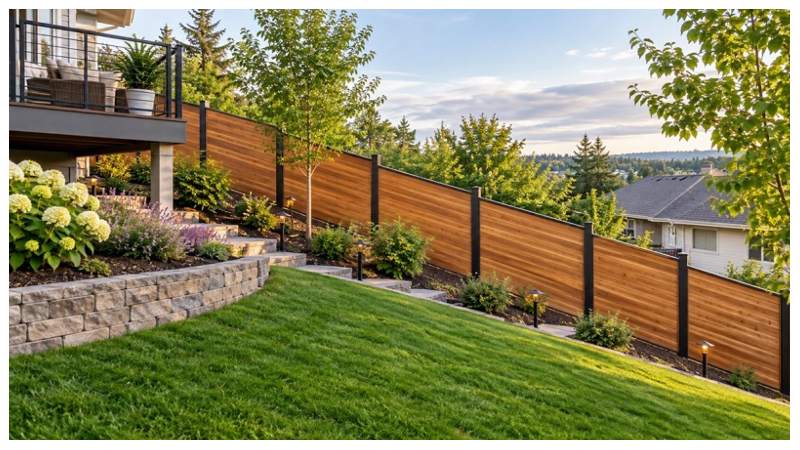
Sloped yards have a way of making a straightforward fencing job suddenly complicated. Posts need to go in at different depths, panels won’t lie flat, and water has a habit of pooling exactly where you’d rather it didn’t. That said, a fence that’s thought through can actually work with the contours of a hilly yard instead of looking like it’s losing an argument with one.
The approach that makes sense depends on your grade, your soil, and what you want the thing to look like when it’s done.
1. Fence Design Options for Sloped Yards
Stepped fencing drops down the slope in level increments – picture a staircase silhouette. Each panel stays horizontal, which looks tidy and structured. The catch is the gaps that open up underneath each step, and if you’ve got dogs or need real privacy down low, those gaps will need some attention.
Contour fencing – racked fencing, if you want the technical term – follows the grade rather than fighting it. Panels angle to match the slope, so the fence line flows rather than jumps. It looks more natural, usually needs less grading work upfront, but the installation is less forgiving. The measurements have to be right.
Terraced fencing takes a different angle entirely: reshape the land into flat sections first, then fence those. It pairs well with retaining walls and garden beds. It also costs significantly more, so it’s usually a choice people make when they’re already doing other landscaping work anyway.
For a lot of yards, combination approaches end up being the practical answer. Contour fencing along the gradual stretch, with stepped sections where it gets steep near a driveway. It takes more planning to keep it from looking chaotic, but it often handles complex terrain better than any single method would.
2. Installation Challenges and Solutions
Slopes complicate most of the standard steps. Post depth isn’t uniform anymore – each one may need to go in differently to stay level and stable. And because wind and soil movement affect an angled fence line unevenly, anchoring matters more than it would on flat ground.
Drainage is worth thinking through before anything goes in the ground. Water moves downhill, obviously, but a fence running across a slope can catch and redirect runoff in ways you didn’t intend. Gravel boards, French drains, or deliberate gaps at the base can keep water moving without it pooling against the posts.
Erosion around post bases is another thing that tends to sneak up on people. Ground cover, mulch, or erosion control fabric can buy time while everything settles. And before any of this starts, check with your local permitting office. Graded land often has its own rules around setbacks, heights, and what requires a permit. Finding that out mid-project is not fun.
3. Material Selection for Sloped Yards
Wood is flexible and works well with both stepped and contour builds. The problem is moisture. The bottom of a slope can stay wet, and wet wood eventually rots. Drainage planning isn’t optional with wood – it’s the thing that determines how long the fence lasts.
Metal – aluminum, steel – handles steep terrain well. It’s rigid enough to support a good contour installation and doesn’t warp or rot over time. Generally lower maintenance, though the upfront cost reflects that.
Composite sits somewhere in between. It looks like wood, resists moisture and insects, and doesn’t need much upkeep. It tends to cost more to start with, but for certain situations it makes sense.
However you build it, sloped sections that take on more runoff will probably need more frequent checks regardless of material. Worth factoring that into any decision.
4. Finding the Right Fit for Your Property
A sloped yard isn’t a dealbreaker for a good fence – it just asks for more thought upfront. The grade, the soil, the design, the material – they all interact, and getting that combination right is what determines whether the fence looks intentional or like an afterthought. Talking through the specifics with OnPoint Fencing or someone who’s installed on terrain like yours is usually the fastest way to avoid expensive surprises.